🗓️
2025
AI and complex thought
What if AI brought us back to complex thinking?
There was a time when knowledge knew no bounds.
Knowledge wasn't a series of checkboxes, but a living whole, woven from intuitions, mysteries, and invisible connections.
Leonardo da Vinci could draw a muscle, design a flying machine, and ponder the nature of beauty—without ever shifting his mindset.
But he wasn't alone.
Averroes (Ibn Rushd), Alhazen (Ibn al-Haytham), Leonardo da Vinci, René Descartes, Alexander von Humboldt, Leibniz, Zhu Xi…
They all shared the same vision: that of an interconnected world, where knowledge, art, nature, and meaning were one.
Then, over the centuries, we sliced this whole into thin slices.
We created disciplines, specialties, silos.
The university separated physics from philosophy, biology from politics, art from technology. And we confused precision with fragmentation.
Complex thinking: an ancient art
Long before Edgar Morin theorized complexity, it already existed, embodied in minds capable of holding together knowledge and meaning, reason and faith.
In Europe,
Leonardo da Vinci painted faces and vortices, observed muscles and clouds, and conceived of art as a science of life.
René Descartes, philosopher, mathematician, and anatomist, dreamed of uniting the rigor of geometry with the clarity of thought.
Alexander von Humboldt saw nature as a vast living network where everything is connected—a precursor to modern ecology.
Leibniz, both a metaphysician and an engineer, already envisioned a “universal language” capable of linking minds and ideas.
In the medieval Muslim world, polymaths were architects of total knowledge. Their erudition did not separate fields of knowledge—it fostered dialogue between them.
They could discuss hadith and geometry, the Quran and medicine, fiqh and logic, optics and psychology with the same commitment to truth.
🎋 Further east, Confucius, Zhu Xi, and Tagore also taught the art of integrated knowledge: science, morality, aesthetics, and spirituality.
These thinkers shared a common thread: they saw the world as a fabric, not a machine.
Their knowledge was not cumulative, but relative, resonant, and alive.
And it is precisely this spirit that Morin's complex thought sought to rehabilitate.
Edgar Morin, the weaver of reality
It is in this fragmented world that Edgar Morin launched his rallying cry.
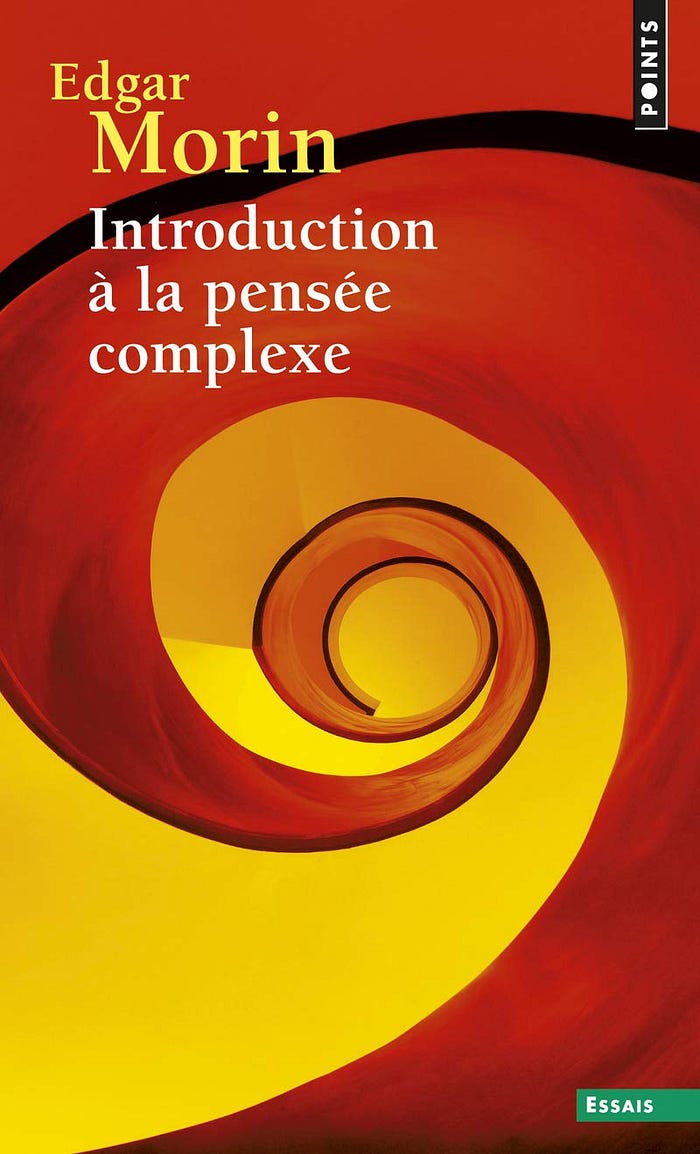
For him, understanding reality means accepting its complexity, that is, its interconnectedness.
The Latin word “complexus” means: that which is woven together. His complex thought is not just another theory: it is an ecology of thought.
It rests on a few simple yet powerful principles:
Connect rather than separate: see how phenomena intersect.
Engage in dialogue with contradiction: hold together the rational and the emotional, order and disorder.
Think in a loop: recognize that the effect feeds back on the cause.
Inhabit uncertainty: do not seek to control everything, but to better understand what eludes us.
Reintroduce consciousness into knowledge: know that to know is also to know oneself.
Morin called for a transversality of knowledge, a return to global, systemic thinking, capable of articulating disciplines, cultures, and temporalities.
⚙️ AI: threat or ally in this complexity?
And now, artificial intelligence has emerged, capable of absorbing all human knowledge, moving effortlessly from one domain to another, and generating code, poems, and theories.
Then a dizzying question arises:
👉 Could AI rehabilitate the complex thought that modernity has fragmented?
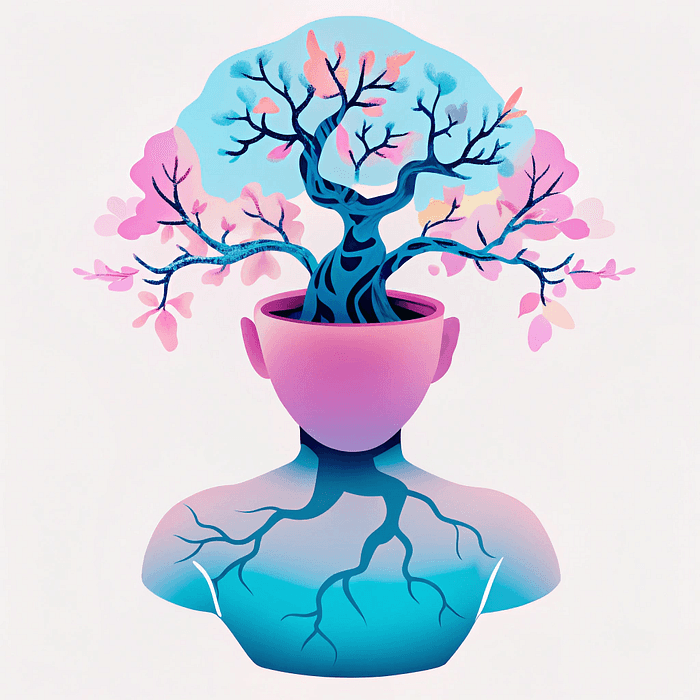
On the one hand, yes.
AI enables cross-disciplinary access to knowledge: it abolishes the boundaries between disciplines, intersects ideas, and creates unexpected connections.
It frees the mind from repetitive tasks, giving humans more time to connect, reflect, and create.
It models complex systems better than we ever could before—climate, ecosystems, networks, brains, markets.
In short, AI is once again enabling us to be navigators of knowledge, explorers of meaning.
It paves the way for the return of the augmented polymath, a human being capable of traveling between science, the arts, philosophy, and technology.
⚠️ But on one condition: maintaining awareness of meaning
As Morin reminded us, complexity isn't just a matter of data; it's a matter of consciousness.
AI can process information, but it doesn't know why it does so. It can describe the complexity of the world, but only human consciousness can inhabit it.
If we relinquish our critical vigilance, AI could reinforce the opposite of complex thought: simplification, immediacy, the illusion of knowledge.
But if we guide it with consciousness, it can become an amplifier of meaning, a pedagogy of connection.
🌱 Towards a new augmented humanism
The challenge of our time is therefore not to choose between humans and machines, but to learn how to connect them.
AI can once again become the tool that leads us back to the spirit of Morin, Avicenna, Descartes, or da Vinci: a world where knowledge is not fragmented, but interconnected; where technology does not replace wisdom, but extends it.
What if the true future of artificial intelligence lies not in imitating man, but in teaching man to think again in all his complexity?